Tuesday, December 24, 2013

The Christmas Task

A wee bit of wishful thinking for Christmas:

The wind tears at my breath as I step outdoors, and I have to concentrate to breath. Exhaling's no problem, but inhaling, stealing a breath back, is a challenge. But as miserable as it feels, the noisy, fretful, wicked wind that drowns out all but the loudest noises and can cause untold and unexpected property damage is why I've chosen this night for what I'm thinking of as "The Task."

I raise my head and see it directly in front of me. My fist tightens around the steak knife I'm clutching like a dagger. I step forward out of the shelter of the porch and look up the street, scanning first one side and then the other. It's after 2 am; only tree limbs are moving. There are no lights in bedrooms or bathrooms. A car glides by on the cross street a block up, but I can't hear its engine over the wind. Good.

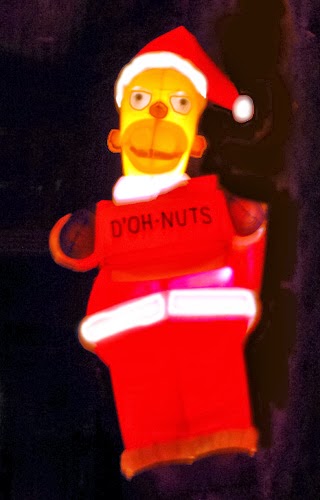
Then I'm running, and I can't hear the wind anymore, only my breath and my feet thudding across the street, up to the house opposite, and I raise my fist and drop the knife, slashing through the nylon fabric that tears, shredding more easily than I had hoped. And then I turn and run back, and am safe inside my own house before the inflatable Homer Simpson dressed as Santa has fully collapsed, never to curse our street again with his tacky, doofy grin.

I just hope next year they don't put up something worse.


Saturday, December 14, 2013

Bertie Sue is SENSITIVE, Y'all

Or picky. Whichever.

A year ago at just about this time, I made a sweater for Bertie Sue. I was inordinately proud of it, because, even if just a dog sweater, it was the first knitted object that I ever conceived of and knitted on my own without a pattern. And it was awesome.

Mostly.

I learned one important lesson while constructing that sweater: You should put the leg holes in where the legs end under the chest, not where they start up at the shoulder. This is an important feature for dog sweaters because doing it wrong adds a lot of unnecessary fabric across the chest and probably makes walking feel kind of funny. Miss Bert would consent to wear the sweater for trips in the car or to go outside for a quick potty, but she refused to go on walks while wearing the sweater. It may be that she is fashion conscious and the grab-bag quality didn't fit her personal style, but I think it's more likely that it felt strange to walk in.

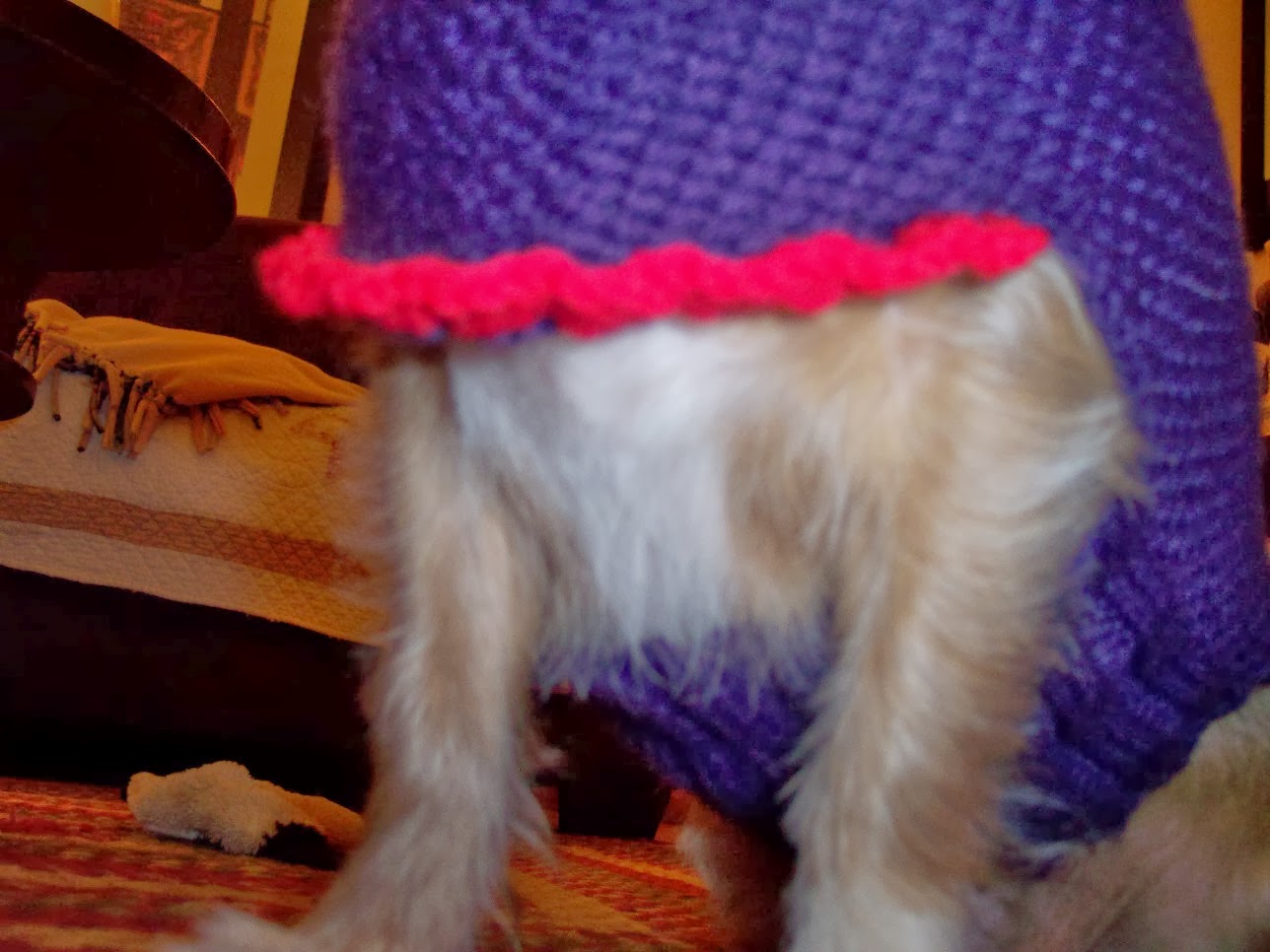
So I cogitated on the problem for a while and decided that the best way to put the leg holes in exactly the right place is to leave them out altogether. Here is the result:


I found the purple mystery yarn in the yarn cabinet wound neatly into a cake with no label. No idea what that stuff is except that a flame test proves it to be an acrylic. (Bert won't be hanging out unattended in this sweater. That stuff melts.) The red ribbing is a design feature in the sense that I ran out of the purple mystery yarn and didn't have anything else to match or coordinate, so I decided to go with full-on clash instead. Embrace the ugly, people. The body is the honeycomb stitch most frequently seen of late in the Honey Cowl. The tummy is all ribbing so that if we manage to help Miss Bert lose the 5 pounds she needs to drop, it will still fit. I hope.

The innovation that made another dog sweater worth knitting is the single giant leg hole.


Sorry about the blurry photo, but that is an insanely difficult angle to photograph and that's the best I could get before Bert wandered off to see if Brew needed to have his rear end sniffed. (He did.)

So far, so good. She can run! She can jump! She can stroll leisurely up the block sniffing every third leaf!

Don't worry that Brewie might be chilly. He's always toasty in his ultra-hip fleece hoodie.


Sunday, September 15, 2013

Reading Journal: Burial Rites

Hannah Kent's first novel, Burial Rites, was published this month by Little, Brown. I don't remember reading an early review or putting it on my holds list, but I must've done both, because it showed up in my box last Wednesday.

Once I had a chance to flip through it, I decided I wasn't going to like it. It's a fictionalized account of the months leading up to the 1830 beheading of Agnes Magnusdottir, the last person ever to be executed in Iceland. It uses available documentary evidence to provide the rough outline of a detailed story purporting to explain the circumstances surrounding Agnes's crime, the murder of the landowner for whom she worked as a servant. Using the character of a priest to draw out the story, Kent provides a fairly explicit and yet hum-drum view of the lives of poor women in nineteenth-century Iceland, which, of course, were no less difficult than the lives of poor women in any other part of the world in that era.

In other words, the conceit is identical to that used by Margaret Atwood in the brilliant Alias Grace, the story of a 19th-century Canadian servant sentenced to death for murdering her master. It's pretty audacious to blatantly imitate one of our greatest living authors, and I expected Kent to suffer in comparison.

I shall now eat my words.  

Kent's writing has a ways to go before she reaches Atwoodian levels of virtuosity, but her story telling instincts more than make up for it. In any case, Kent's straight-forward, one might say plain, style does service to her characters, people who, though literate and intelligent, live lives much too difficult and exhausting to engage in artistic pursuits that don't serve some useful purpose on the farm.

I found myself drawn into the details of running a farm in pre-Industrial Revolution Iceland, a climate an outsider might find much too forbidding to be worth the effort. From the window pane made of a pig bladder to the sleeping arrangements in the badstofa, Kent, herself an Australian, provides realistic but not excessive detail of what it meant to live and farm in a region where the weather can kill you 9 months out of the year.

And, more urgently, Kent tells the story that could belong to any poor woman servant from any era, including our own, subject to the whims of her "betters" and unable to fully act on her own desires and needs. The danger of stories like Burial Rites and Alias Grace is the temptation to classify these stories exclusively as horrors from the past. "That doesn't happen now," we tell ourselves. Yet of course it does. The bare fact of poverty in the 21st-century United States puts one at risk of victimization and exploitation; the risks for poor women are double. So when we read novels like Burial Rites, although it's oh so tempting to classify it merely as historical fiction, Agnes herself begs us to examine our own world in search of injustice and exploitation that, though perhaps better camouflaged, is no less prevalent. This is where Kent's novel truly succeeds.


Tuesday, August 20, 2013

An Open Letter to Minneha Elementary School Students and Staff

What a way to start the school year! You enter your classrooms excited to begin another year, and what do you get? A "scandal" created by people who don't seem to understand the purpose of education in general, let alone the mission of Minneha Core Knowledge Magnet in particular.

I'm sorry you had to take down your display depicting the Five Pillars of Islam. I hope you'll be able to replace it soon. You know better than many adults that learning about different religions is a great way to move toward a peaceful world. You know that pretending religion doesn't exist is a prescription for ignorance and bigotry later in life. You know that learning about a religion is not the same thing as believing. And your teachers know that the Supreme Court has upheld the right of public schools to provide education about religion at the same time that it rightly prohibits proselytizing in McCollum v Board of Education (1948) and in School District of Abington Township v Schempp (1963).  

So when it's time to do your unit on Islam later this fall, just like when you do your units on Christianity, Buddhism, Judaism, and Hinduism, don't let the bullies intimidate you from learning. They're afraid because they don't know any better. You can be brave because you have knowledge.

Thursday, August 1, 2013

A Profound Metaphor of Significant Significance (but mainly dog training)

My dad came over this morning to do something mysterious to my stereo to make the classical station in Hutch come in more clearly. (And by "mysterious," I mean he stuck a piece of flexible, rubber-coated wire in the antenna port. The wire has a name, but I've already forgotten. Dad would want me to tell you that you should NEVER attach a wire coat hanger to your stereo. Not that I would ever consider that. Ahem.)

So, knowing that we were about to have company, I did what I always do to make Brewster more comfortable with visitors. The dogs got their harnesses on, and we went out for a mini-walk so we could meet Dad outside. Brewster is much happier to meet people outside on neutral ground than to have them come into his house. Bertie is always happy to meet new people so she runs up first to perform her official function as the Chez Furry Pants Welcoming Committee. (Obviously this special service is only for guests we already know are dog people and won't mind slobbery dog tongue.) Then in theory Brewster and I follow, Brewster gets to meet the guest if he's feeling brave enough, and then we follow the guest into the house so Brew doesn't feel like he's being chased. 

When Dad came by a couple of weeks ago, we did not do this very well. Or rather, I did not do it very well. Bertie ran up to Dad, and I held Brewster back to see how he would react. In the process of holding him back, I pulled back on his leash, putting tension on it. And there was the mistake.

The amount of tension on the leash makes a huge difference in how Brew reacts. When his harness is tight around his chest, he lunges forward and wants to attack. When there is no tension he almost literally seems like a different dog, a bit nervous and timid, but in no way aggressive or threatening. This is not just a Brewster thing. I learned in an obedience class that all dogs respond to tension in the leash by becoming tense themselves. Understanding this basic little factoid was what made it possible to successfully introduce Brewster to Bertie Sue way back when. 

So at Dad's last visit, when Brewster felt the tension in the leash, it caused tension in him, and he wanted to lunge forward. I knew that I was causing the problem, but I couldn't make myself stop doing it. I knew if I released the tension, he would charge up at Dad for just a second, and the image of snarling Brewster was just too much. I wound up holding Brewster the entire time Dad was at the house, afraid to put him down.

Today I was determined to do better--not that Brewster would do better, that I would do better. When Bert ran up to give Dad his hello kisses, Brewster and I kept right on coming. Brewster tried to pull forward, but I kept coming, too, so the leash was slack. And I swear to you I saw this thought bubble forming over Brewster's head: "You aren't going to pull me back? You mean I could actually run up and bite him if I want to? Um . . . I think I'll go check out this piece of grass over here. Here's a rock that needs to be sniffed. This dandelion must be peed on immediately." And Brewster spent the rest of the visit ignoring Dad entirely, which is fine because Bertie Sue hands out enough luvins for four dogs. I promise, no one has ever felt neglected since Bert came to live here.

Hence, today's moral. You've heard the saying that life is 10% what happens to you and 90% how you react to it, or something like that. So it is with dog training: The trick to improving a dog's behavior often lies in the handler's willingness to change his or her own behavior. Brewster didn't do a single thing differently at today's visit versus what he did two weeks ago. I was the one who changed my technique to get different results. And, whereas two weeks ago, I spent my time restraining an angry little demon dog, today I spent my time reassuring a nervous but generally calm and certainly not dangerous sweet little angel of whom I am very proud. Worth it.


Tuesday, July 30, 2013

A Knitter's Word Problem

Noelle accidentally knit an extra pattern repeat, including increases, on the yoke of the February Lady Sweater. She now has 235 stitches, but she only needs 227. Should she:

A. Tink back 470 stitches.

B. K2tog 8 times.

C. You know you can buy sweaters at Target, right?


Next week's problem: If Knitter 1 leaves the LYS at 10:45 am with a bag of Malabrigo and Knitter 2 leaves Michael's at 11:02 with a bag of Patons Kroy, they will have a violent and virulent disagreement on Ravelry about yarn quality at what time?

Thursday, July 4, 2013

Here There Be Monsters, Y'all! No, really.

I've discovered the solution to the tepid second novel that critics' lore insists a promising young novelist will inevitably produce. Just wait and read the second novel first, and then go back and read the first. Earlier this year I read Arcadia, Lauren Groff's second novel. It was good. Darn good, in fact. So good it was one of the contenders in the Tournament of Books.

But I just finished The Monsters of Templeton, Groff's debut novel published in 2008, and it blew Arcadia right out of the water. Monsters has, well, a monster. A real one. We're not talking some metaphoric mental monster, but an actual, honest-to-god, lives-in-the-lake, and may-or-may-not-be-drowing-people monster.

And yes, okay, the monster is in fact symbolic of the monstrous secrets being kept in the town that surface at the same time as the monster. It wouldn't be lit-rah-cha if there wasn't any symbolism, of course. But Groff took what could've been an average novel on well-worn themes (daddy issues much?) and pulled the story-telling equivalent of lifting a rabbit out of a top hat. Except the rabbit isn't a boring old rabbit. It's a monster. A real, live monster, "huge, a heavy cream color that darkened to lemon in places. . . . It looked like a carp grown enormous, with a carp's fat belly and round eye, but with a long, articulated neck like a ballet dancer's and four finned legs, plump as a frog." When was the last time you got to read about a monster outside of a horror novel? Never, yeah?

On more, shall we say, traditional grounds, the novel is just as skilled as Arcadia. It looks at similar themes in terms of what constitutes a family, how perceptions and knowledge are formed, and what happens when a new reality intrudes. The main character, Willie Upton, searches her family's history to reveal her own "monsters," which for the most part aren't that monstrous, but really are only the departures from "authorized" history that happen in every family. As Willie explores her family's history back to her founding ancestors in the 18th century, Groff explores the quintessential American family in microcosm, and thus presents us with a portrait of our own American geniture. Although Willie is the protagonist who must live with the consequences, Groff lets each generation tell its own story and make its own confessions. Each generation's story is layered on another, not necessarily in chronological order, creating new understandings of what it means to be Willie Upton, and, for the rest of us, what it means to be a descendent of the American experiment—although that really sounds too grand for the immediate, intimate nature of this story.

As in Arcadia, Groff's prose is impressive. It manages to be exquisite and delicate without looking like she tried to make it exquisite and delicate. In the course of the week or so that I was reading Monsters, I found myself thinking in Groff's voice, the way you do when you're engrossed in a novel. Letting an author infect my brain like that is probably the highest praise I can give any writer.

So you must definitely read The Monsters of Templeton, not least because it is a relevant story told in beautiful prose. But mostly you must read Monsters because of the monster. How often as an adult do you get to read about a monster you can really believe in?

Oh, and the friendly if somewhat anal-retentive ghost. Did I mention the ghost? I can't believe I forgot to tell you about the ghost!