Like most mommas, I want so badly to believe that my little ones, four-legged though they may be, are smarter than all their little friends. Unfortunately, evidence demonstrates otherwise. Last night, for example, Bertie Sue spent several minutes determinedly trying to get underneath a blanket she was sitting on top of.
And then there's the door.
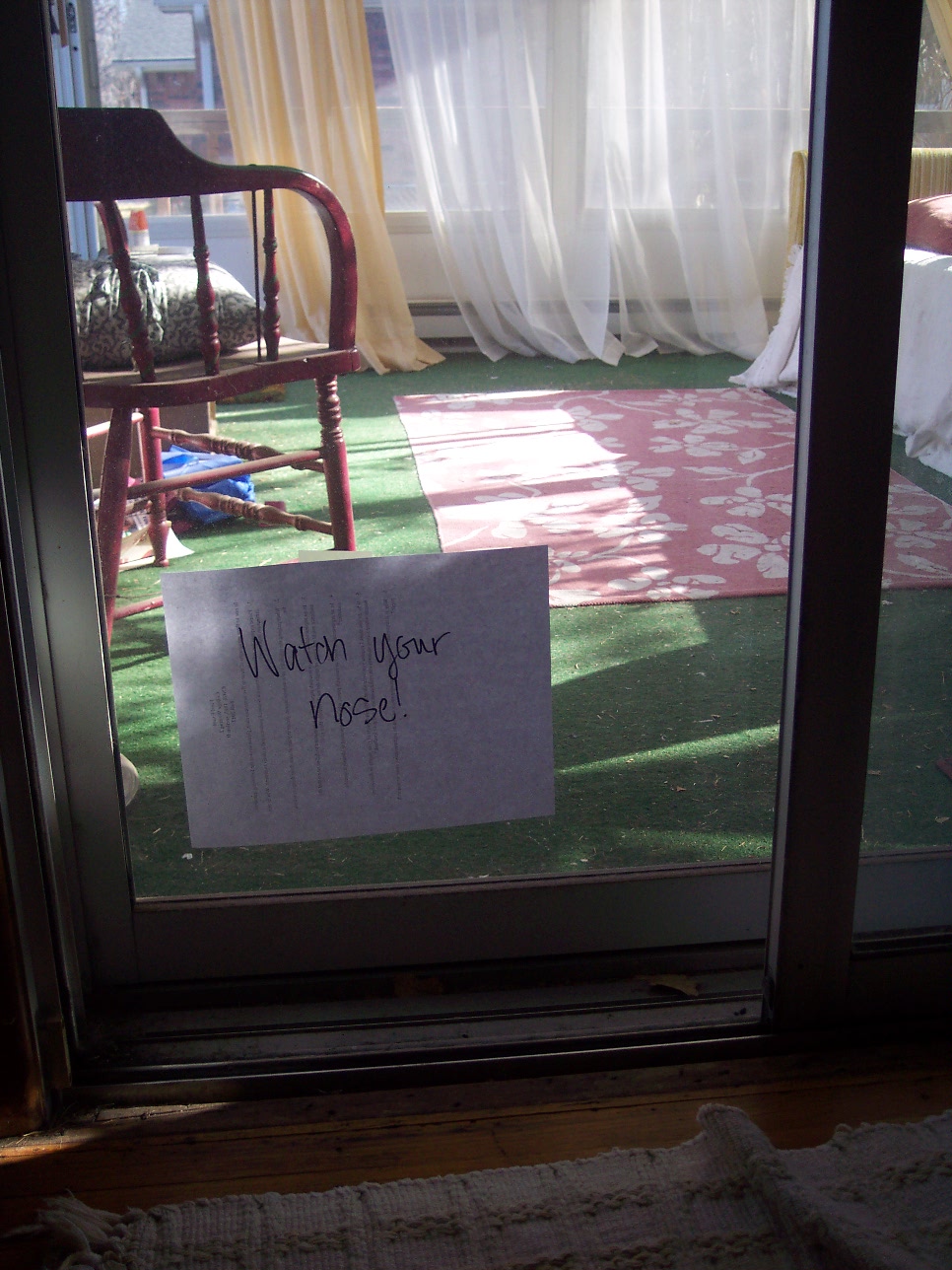
The back porch sliding door has a storm door that I only shut when it's cold. Yesterday I shut it, which means that when the dogs go out, they have to wait for two doors to open instead of one. They can't seem to remember this. They've each bonked their noses three times apiece, now. I'm hoping this will help:
I know they can't read. But I'm their momma, and I believe they can learn. I dare you to tell me otherwise.
Update: So far from bonking his nose, the sign worried Brewster so much that he had to back up and watch it suspiciously for a bit before he could get near it. I forgot that sometimes doorways are scary, and something different is likely to cause more than usual trepidation. But at least he didn't bonk his nose.
Monday, December 10, 2012
Tuesday, December 4, 2012
An Ending I Did Not Like
In 2012, Gillian Flynn published her third novel, Gone Girl, and it got a lot of press and was a really big honking deal. So when I accidentally left the house the other day without a book or knitting, and I had some waiting in line to do, Gone Girl was the novel I intended to pick up. But a paperback by the same author was sitting right there, and a paperback is cheaper and fits in your purse, so the decision was purely practical. All the best literature is reasonably priced and portable, right? Plus, whereas Gone Girl is about a marriage, something of which I have little knowledge and no experience, Dark Places is about a girl raised by a single mom in Kansas in the 1980s. I've got some personal stake in that story. And that's why I'm proffering my opinion about 3-year-old Dark Places instead of the newer novel.
I have to admit that I don't know the ins and outs of writing a "legitimate" book review. Maybe I should read a few, eh? But I cannot help but whine about how disappointed I was in Dark Places. The ending was so silly it verged on nonsensical. It's as if Flynn thought up a murder and wrote and wrote and wrote, and suddenly realized she didn't know how to solve it. So she figured out an answer that would fit the situation she had set up for herself--a ridiculous answer, but an answer--and then went back to an earlier chapter to toss in some foreshadowing and called it good.
Which is not to say that I didn't love Dark Places. I absolutely did, and that makes the disappointment all the more potent. That final nonsensical plot point aside, Flynn is a genius writer. Her characters are just like all those assholes you knew in school or at the bar. And they are all assholes to some degree, even the narrator. In other words, they're real people. Libby Day, now in her mid-30s, is on a quest to solve the murders of her mother and two sisters that happened when she was only 7 not because of a sense of duty or honor, but simply for money. She is not compelled to avenge her family; she is compelled to pay the rent. Otherwise, she'd just as soon stay in bed. (Frankly, I can relate to that, too.) A reader tempted to feel sorry for Libby won't feel that way for long. Having made a living on the pity people feel for her, Libby well understands the process of manipulation, but manipulation is not the purpose of Flynn's story. Libby's telling of her own life is straightforward and unflinching. Flynn never gives the reader a chance to indulge in the maudlin pity that a lot of writers wouldn't be able to avoid.
And that's why we love Libby. We know she's a manipulator, a thief of both unconsidered trifles and her supporters' sympathy, but she isn't stealing anything from us. In fact, she's giving us something--entry into her tightly controlled life. We also incidentally get a clear-sighted analysis of the worst possible scenario of 1980s rural poverty, alcoholism and addiction, absentee parenthood, the satanism-molestation panic, and even the farm crisis. Flynn reminds us that the 1980s had problems a lot bigger than mullets and parachute pants.
So even though the ending made me yell "That's so stupid!" I still loved Dark Places. A splendid novel isn't damned because of one flaw anymore than Libby herself is damned because of one horrid night.
I have to admit that I don't know the ins and outs of writing a "legitimate" book review. Maybe I should read a few, eh? But I cannot help but whine about how disappointed I was in Dark Places. The ending was so silly it verged on nonsensical. It's as if Flynn thought up a murder and wrote and wrote and wrote, and suddenly realized she didn't know how to solve it. So she figured out an answer that would fit the situation she had set up for herself--a ridiculous answer, but an answer--and then went back to an earlier chapter to toss in some foreshadowing and called it good.
Which is not to say that I didn't love Dark Places. I absolutely did, and that makes the disappointment all the more potent. That final nonsensical plot point aside, Flynn is a genius writer. Her characters are just like all those assholes you knew in school or at the bar. And they are all assholes to some degree, even the narrator. In other words, they're real people. Libby Day, now in her mid-30s, is on a quest to solve the murders of her mother and two sisters that happened when she was only 7 not because of a sense of duty or honor, but simply for money. She is not compelled to avenge her family; she is compelled to pay the rent. Otherwise, she'd just as soon stay in bed. (Frankly, I can relate to that, too.) A reader tempted to feel sorry for Libby won't feel that way for long. Having made a living on the pity people feel for her, Libby well understands the process of manipulation, but manipulation is not the purpose of Flynn's story. Libby's telling of her own life is straightforward and unflinching. Flynn never gives the reader a chance to indulge in the maudlin pity that a lot of writers wouldn't be able to avoid.
And that's why we love Libby. We know she's a manipulator, a thief of both unconsidered trifles and her supporters' sympathy, but she isn't stealing anything from us. In fact, she's giving us something--entry into her tightly controlled life. We also incidentally get a clear-sighted analysis of the worst possible scenario of 1980s rural poverty, alcoholism and addiction, absentee parenthood, the satanism-molestation panic, and even the farm crisis. Flynn reminds us that the 1980s had problems a lot bigger than mullets and parachute pants.
So even though the ending made me yell "That's so stupid!" I still loved Dark Places. A splendid novel isn't damned because of one flaw anymore than Libby herself is damned because of one horrid night.
Labels:
Dark Places,
Gillian Flynn,
Gone Girl,
reading journal,
TOIA Books
Sunday, December 2, 2012
This Thing I Made
It might be stretching it to call this a "design," but let's stretch it just for fun. Without further ado:
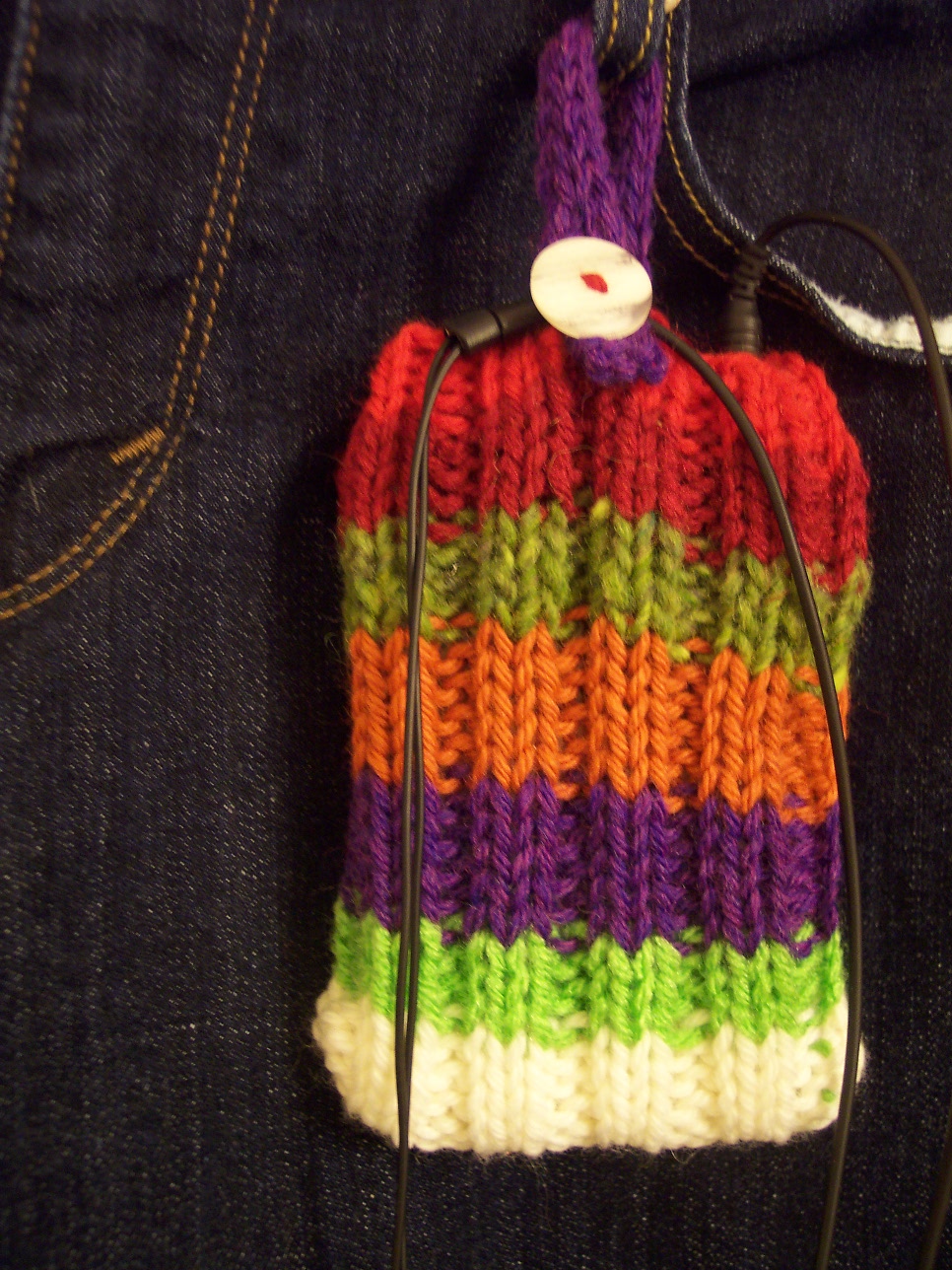
The Grab-Bag iPod Sweater!
Directions:
1. Put some leftover yarn in a bag. You know, so you can grab it.
2. Choose double-pointed needles appropriate to your yarn. In this case, you're looking at mostly worsted weight, except for the orange, which is more of a DK, on size 7 needles.
3. Check your gauge. Ha! Ha! Just kidding! It's a sweater for an iPod. Let it go.
4. Reach in your bag and grab a color, and cast on an even number of stitches in multiples of 4. I cast on 36 stitches for my 2.25-inch-wide iPod. I probably could've gotten away with 32. However many you choose to cast on, make sure it's an even number in multiples of 4, unless you happen to like wonky ribbing.
5. Divide your stitches over three or four needles, and join to knit in the round. Do I need to tell you to be careful not to twist your stitches? I didn't think so. Use a stitch marker to mark the beginning of the round if you want, but for a project this simple, real Knitters just keep an eye on the tail to find the beginning of the round. Are you a Knitter or a mouse?
6. Go to town knitting 2x2 ribbing. Knit with your first color until you're tired of it or you run out. Then grab another color. Continue on, switching colors as the mood strikes you, until you have a tube of ribbing long enough to hold your iPod, about 4.5 inches, or whatever it is you're knitting a sweater for. (I don't want to know. This is a family-friendly blog, people. More or less.)
7. Move your stitches onto two needles (I divided my 36 stitches into two groups of 18), and kitchner the toe. Okay, it's not a toe, but it's late and I knit socks, and I honestly can't think of a reasonable word for the bottom of an iPod sweater. Probably "the bottom of an iPod sweater." (If you don't know how to kitchner, just search online. There are dozens, if not hundreds, of written explanations and YouTube videos more eloquent than I am capable of writing at the moment.)
8. Pick up four stitches at the top middle back of the sweater and begin knitting an i-cord handle. The back of the sweater should be facing you so that when you fold the i-cord over to button in front, the front of the i-cord will be facing the same direction as the front of the sweater. Does that make sense? I hope so. If not, please feel free to send me snippy letters. I'm a college instructor. I can take it.
9. Knit your i-cord as long as you'd like. I wanted mine to button onto the belt loop of my jeans or the handle of my lawn mower, so I kept it short--about 2.5 inches. A slightly longer cord would fit nicely over your wrist.
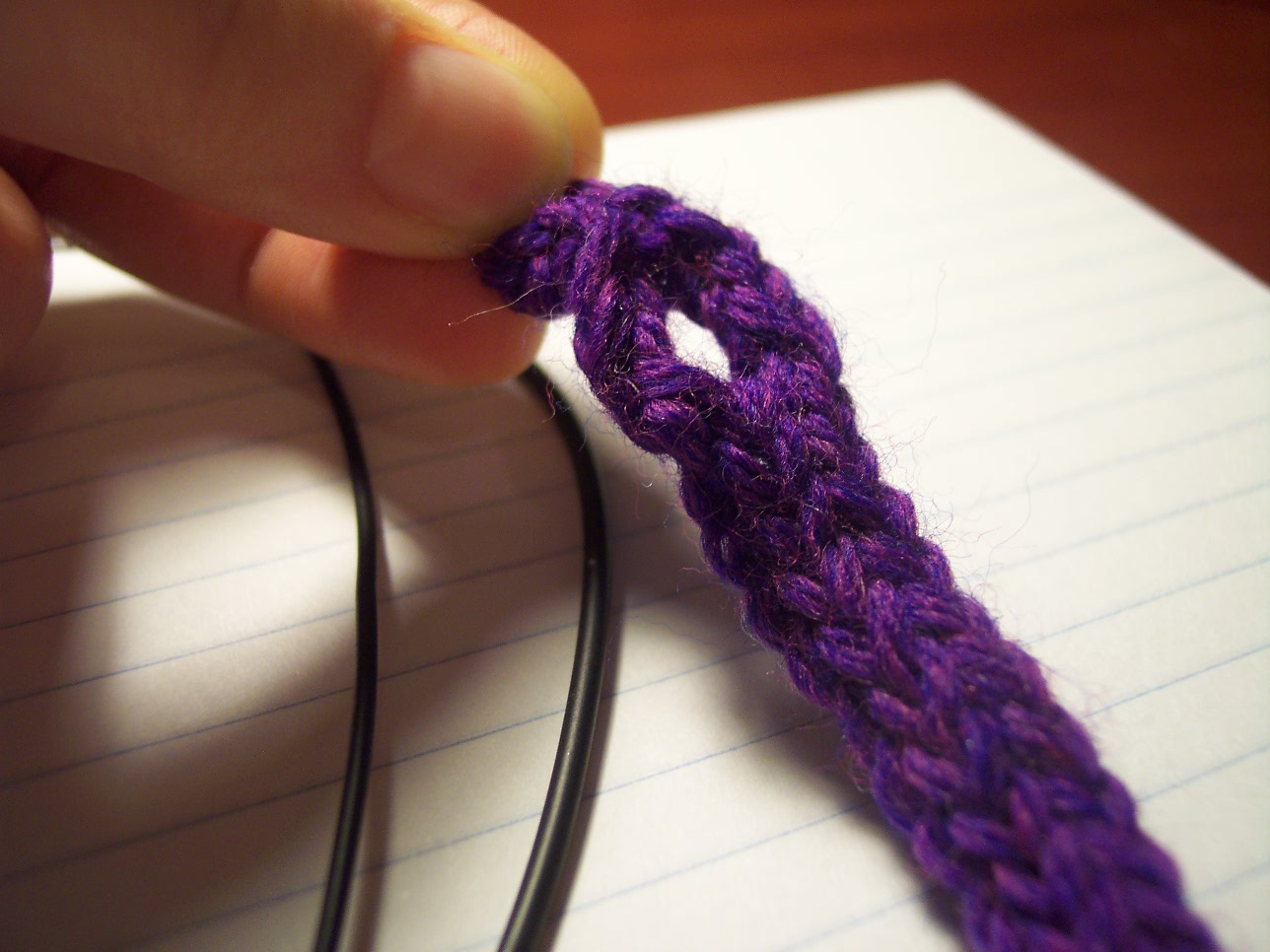
10. Now you need to create the button hole in the i-cord, and this is the part I'm kind of proud of. I'm pretty sure I thought this up myself. Google gives some results for "button hole in i-cord," but I can't see any like mine, and mine is better because you don't have to cast off and re-cast on. So try it. To knit a button hole into the i-cord, put the 2 far left stitches on waste yarn or a spare needle, and just work the 2 right stitches as its own little i-cord for 3 or 4 rows. (If you've already picked a button, you can guesstimate how much space you'll need. Generally, the answer is less than you think.) Then stop working the right stitches, and go back and work the 2 left stitches for the same number of rows. You'll need to use a different piece of yarn. I used the yarn from the outside of the center-pull ball. When you've worked the same number of rows on both sides, start knitting all 4 stitches together again for another row or two, and then bind off however you would normally choose to end a piece of i-cord. Totally up to you. This is your show, man.
11. Pick a button from your button collection that will fit through your button hole and sew it on the front wherever you want it. If you don't have a button collection, start a button collection.
12. Weave in all your ends. Or tie them in knots. Again, it's a sweater for an iPod. Quality is important in any undertaking, but let's not overdo it.
13. Post on Facebook about how you just knit a whole sweater in 2 hours. Your knitting friends will be all, "Wait. What?" Your non-knitting friends will be all, "God, will she ever shut up about knitting? But if she stops talking about knitting, she'll start talking about her dogs again. Where is that mutherfreakin Hide button. . . ."
P.S. No, this has not been tech edited. Again, it's a sweater for an iPod. I got the idea while I was in the shower this morning, and I knit it tonight while watching Wheel of Fortune and It's a Wonderful Life. If you find a mistake, let me know and I'll fix it.
P.P.S. For personal use only. You should please not sell this "pattern" or anything made from this "pattern," such as it is. If anyone's going to make money off this booger, remote as that possibility is, it's going to be me.
Friday, November 30, 2012
Knitting Sounds
knit
knit knit purl. knit knit knit purl yarnaround.
knit
knit knit purl. knit.two.together. knit knit knit purl.
Knitting needles are supposed to
“click.” That’s always in novels, about how some character’s needles “clicked.”
Miss Marple, Madame Defarge, it doesn’t matter whether she’s a spinster
detective or the secret record keeper of a revolutionary outrage. If there’s a
woman knitting in a book, her needles click.
My
needles don’t click unless I make them.
Of
their own accord, my needles don’t make any sound at all except when I cuss.
The
only sound of knitting is in my head, and it goes knit knit knit purl. knit
knit knit purl yarnaround. knit knit knit purl. knit.two.together. knit knit
knit purl. Of course not always those stitches in that order. Now yarn, it
makes a sound, especially when the ball is wound a little too tight.
“Fuuuuurze” is the sound it makes until enough yarn has been pulled out to
loosen the ball a little bit. It’s that sound that can make your teeth tingle
if you listen too close. So I try not to listen.
Knitting
is silent, and isn’t that the point? The sounds are around you. There’s the
occasional car passing out on the highway, going too fast, even the ones just
doing the speed limit. That shepherd mutt in the next block, barking, bored and
angry on its chain in the dust. In the summertime the cicadas yelling at the
whole world, angry as hell, they’re not sure about what, but they’re damn sure
going to tell us all about it. (Anybody ever nominate a cicada for political
office? They’d fit right in and be about as much use.) The sounds are around
you, but when you’re knitting, you don’t have to listen. The inner sounds are
the ones that matter.
knit
knit knit purl. knit knit knit purl yarnaround.
knit
knit knit purl. knit.two.together. knit knit knit purl.
Monday, October 15, 2012
Saturday, October 13, 2012
Noelle Solves Politics
As the election cycle enters its most contentious phase, I would like to propose new nonpartisan terms of use requirements for
all social media sites. Any person making a political post must
acknowledge the following:
(1) Such posts have no influence on members of the opposing parties. What you perceive as "facts" the other side views as blatant distortion, if not outright hogwash, and vice-versa. And as much as it pains us all to admit it, "they"--whomever "they" might be from your perspective--are not stupid, or at least no stupider than "we" are.
(2) As such, the purpose of political posts is:
(a) to entertain people who already agree with you
(b) to express one's own opinion without any expectation of convincing opponents
(c) to piss off people who disagree with you
With these terms of service requirements firmly in place, we can all happily ignore each other and still be friends after the election.
P.S. Democrats Rule! Republicans drool!
(1) Such posts have no influence on members of the opposing parties. What you perceive as "facts" the other side views as blatant distortion, if not outright hogwash, and vice-versa. And as much as it pains us all to admit it, "they"--whomever "they" might be from your perspective--are not stupid, or at least no stupider than "we" are.
(2) As such, the purpose of political posts is:
(a) to entertain people who already agree with you
(b) to express one's own opinion without any expectation of convincing opponents
(c) to piss off people who disagree with you
With these terms of service requirements firmly in place, we can all happily ignore each other and still be friends after the election.
P.S. Democrats Rule! Republicans drool!
Wednesday, October 10, 2012
TOIA Ghost Stories
Stop with the lists already! There's the list of Nobel literature winners that I am emotionally invested in someday completing. (And the 2012 winner will be announced tomorrow. Eek! The suspense!) The National Book Award announced its list of finalists for 2012 this morning, and of course I should probably also read all the winners of the Pulitzer in fiction. At least that list only goes back to the 1950s.
And then there's Time Magazine's completely arbitrary--and sometimes bizarre--list of the 100 best novels since 1923. Are You There, God? It's Me, Margaret? Seriously? Okay, fine, yes, "We must, we must, we must increase our bust" was very influential for me. But of all the 20th-century YA novels in all the world, that's the one they picked? Really? It's like they realized at the last minute that less than a quarter of the authors on their list were women, and they thought that if they tossed us a book about menstruation, we wouldn't notice. So forget the Time list.
But still, that's a lot of reading. What's a girl with three jobs and a steady knitting habit to do?
Chuck it, that's what, and in honor of October, dive into some deliciously terrifying ghost stories.
A local bookstore advertised a pretty good sale last week, and so of course I ran right over to see what I could find. The display table at the front door had a great Halloween display, and The Big Book of Ghost Stories practically leapt into my hands. But I wasn't there to pay full price, so I put it back and wandered around the sale tables. Nothing appealed. In three tables of obscenely cheap books, I couldn't find one single thing I wanted, which has to be a lifetime first for me. Mysterious, right? Almost supernatural, one might say. And all the while, The Big Book kept calling me back, almost as if a mysterious presence wanted me to buy it.
Let's talk for just a moment about how I have never, ever enjoyed even the most highbrow vampire literature--we're talking The Historian, not Twilight--for the very simple reason that I don't believe in vampires. And yet ghosts are not a problem for me. I'm not saying that I believe in ghosts. But, yes, I absolutely believe in ghosts. I mean not really. But, yes, really.
So The Big Book came home with me, Gabriel Garcia Marquez got temporarily relocated to the coffee table to-read pile (catch you in November, Gabe), and, except for that first night when I kept waking up and thinking my robe was a navy-blue ghost hovering at the foot of my bed, I haven't regretted it.
With the crazy that is my life right now, what with copyediting and grading (Did I really need to assign so many essays? No. No, I did not.), short stories are the perfect format for my frazzled mind. And the selection in this book is wide, and, what's even better, obscure. Of the 80 stories, the only one I've already read is "The Monkey's Paw," and the stories range from at least the 19th century through contemporary authors like Joyce Carol Oates. They're arranged not by date but by theme, so stories about love are grouped, as are stories about kids, stories about dreams, and stories that are supposedly funny.
That last is the category I was most looking forward to, but of the three I've read, Mark Twain's "A Ghost's Story" is the only tale that doesn't disappoint. Oscar Wilde's "The Canterville Ghost" starts out funny, but edges into melancholia in the final pages, as if he didn't know how to finish it. And "In at the Death" by Donald Westlake, "the funniest mystery writer who ever lived," according to editor Otto Penzler, is flat-out tragic and demoralizing. I'd someday like the chance to explain to Mr. Penzler that "irony" and "funny" are not automatically the same thing.
But other than that, I've enjoyed every moment of my ghostly detour, and with the number of stories in this anthology, I'm guessing I'll be enjoying them for two or three more Octobers to come. Now if you'll excuse me, I have to gather my furry protectors around me and sample Ellen Glasgow's "The Shadowy Third." Luckily, I live near my mommy, and I can be huddled under her bed covers in 7 minutes flat if need be. So, Mom, leave the deadbolt off just in case, okay? All month. Thanks!
Update: "The Shadowy Third" was excellent. Even though Glasgow never explains exactly how the ghost became a ghost, the payoff at the end is both surprising and satisfying.
And then there's Time Magazine's completely arbitrary--and sometimes bizarre--list of the 100 best novels since 1923. Are You There, God? It's Me, Margaret? Seriously? Okay, fine, yes, "We must, we must, we must increase our bust" was very influential for me. But of all the 20th-century YA novels in all the world, that's the one they picked? Really? It's like they realized at the last minute that less than a quarter of the authors on their list were women, and they thought that if they tossed us a book about menstruation, we wouldn't notice. So forget the Time list.
But still, that's a lot of reading. What's a girl with three jobs and a steady knitting habit to do?
Chuck it, that's what, and in honor of October, dive into some deliciously terrifying ghost stories.
| My bedside table is temporarily haunted. |
Let's talk for just a moment about how I have never, ever enjoyed even the most highbrow vampire literature--we're talking The Historian, not Twilight--for the very simple reason that I don't believe in vampires. And yet ghosts are not a problem for me. I'm not saying that I believe in ghosts. But, yes, I absolutely believe in ghosts. I mean not really. But, yes, really.
So The Big Book came home with me, Gabriel Garcia Marquez got temporarily relocated to the coffee table to-read pile (catch you in November, Gabe), and, except for that first night when I kept waking up and thinking my robe was a navy-blue ghost hovering at the foot of my bed, I haven't regretted it.
With the crazy that is my life right now, what with copyediting and grading (Did I really need to assign so many essays? No. No, I did not.), short stories are the perfect format for my frazzled mind. And the selection in this book is wide, and, what's even better, obscure. Of the 80 stories, the only one I've already read is "The Monkey's Paw," and the stories range from at least the 19th century through contemporary authors like Joyce Carol Oates. They're arranged not by date but by theme, so stories about love are grouped, as are stories about kids, stories about dreams, and stories that are supposedly funny.
That last is the category I was most looking forward to, but of the three I've read, Mark Twain's "A Ghost's Story" is the only tale that doesn't disappoint. Oscar Wilde's "The Canterville Ghost" starts out funny, but edges into melancholia in the final pages, as if he didn't know how to finish it. And "In at the Death" by Donald Westlake, "the funniest mystery writer who ever lived," according to editor Otto Penzler, is flat-out tragic and demoralizing. I'd someday like the chance to explain to Mr. Penzler that "irony" and "funny" are not automatically the same thing.
But other than that, I've enjoyed every moment of my ghostly detour, and with the number of stories in this anthology, I'm guessing I'll be enjoying them for two or three more Octobers to come. Now if you'll excuse me, I have to gather my furry protectors around me and sample Ellen Glasgow's "The Shadowy Third." Luckily, I live near my mommy, and I can be huddled under her bed covers in 7 minutes flat if need be. So, Mom, leave the deadbolt off just in case, okay? All month. Thanks!
Update: "The Shadowy Third" was excellent. Even though Glasgow never explains exactly how the ghost became a ghost, the payoff at the end is both surprising and satisfying.
Subscribe to:
Posts (Atom)