A few years ago I was messaging a friend from out of town and I absent-mindedly referred to "ICT." "What's that?" she wanted to know. It's the code for the Wichita airport, which has somehow become local shorthand for the city itself. Do people in Kansas City refer to their town as "KCI"? Do Los Angelenos talk about the city as "LAX"? I kind of doubt it. It's weird. But it's everywhere, including in the name of this year's reading challenge put together by Suzanne Tobias of the Wichita Eagle and supported by the Wichita Public Library.
The challenge requires 12 books from 12 categories to be read any time during 2018. I, of course, am enthusiastically participating--so enthusiastically, in fact, that I locked a co-worker in a supply closet so I could take her spot in the library's online book club, which you can watch here if you haven't already deleted your Facebook account. (She wasn't really locked in a closet. She was stuck in the Chicago airport during a snowstorm. That's almost the same thing, though.)
I'm three books into the challenge and so far there hasn't been a dud in the bunch:
Murder and Other Acts of Literature is filling slot 8 for an essay or short story collection. The variety in this collection was entertaining and writers who normally don't tickle my toes made me sit up. Virginia Woolf made me laugh! I mean really. Should I reassess Mrs. Dalloway? No, of course not, don't be silly. But the short stories in this collection were a fun read.
Leopard at the Door is my category 4, "a book set somewhere you've never been." Set in Kenya, Leopard is narrated by the adult daughter of an British colonial planter during what the British referred to as the "Mau Mau uprising" and Kenyans referred to as the "Mau Mau rebellion." These words matter. Americans may not be familiar with the history described here, which complicates the pastoral images we have of colonialism that we get from works like Out of Africa. I'm looking forward to following this one up with A Grain of Wheat, by Ngugi Wa Thiong'o, a Kenyan writer who fictionalizes events from the same era.
And of course, Magpie Murders is filling category 2 for a detective novel or true crime book. If you watched the video linked above, you already know how I feel about this book, which is a detailed homage to the British murder mystery beginning with the genre's progenitor, Sherlock Holmes, through the present-day craze for police procedurals, with particular emphasis on Agatha Christie's country house murders.
Twelve books in twelve months? You can do it! I can do it! Find the categories and sign up on http://wichitalibrary.org/readict.
Thursday, March 29, 2018


Thursday, February 22, 2018
It Took a Year
It was almost exactly a year ago, in fact, when the cowl I was knitting in Andreality's (Ravelry name) birthday Malabrigo got suddenly and unceremoniously pushed aside for some new, shiny projects:
I had to make these:
And then there was this:
And of course that:
I'm finally healthy and off the couch, but I feel like I'm on a roll with the UFOs, so I went rummaging again and came up with some yarn barf that's been rolling around in a project bag since 2013.
 |
| A plain sock pattern over 32 stitches on size 2 needles. |
And then there was this:
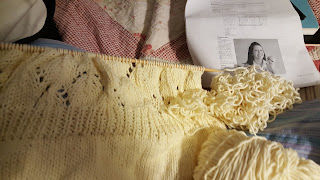
 |
| The Welcome Home Baby Blanket from Lace One-Skein Wonders. |
And of course that:
 |
| Elijah by Ysolda Teague. |
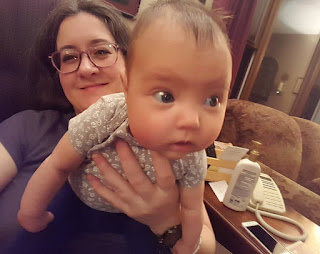
Because when a new niece is about to launch herself into your life, there's a lot of knitting to do!
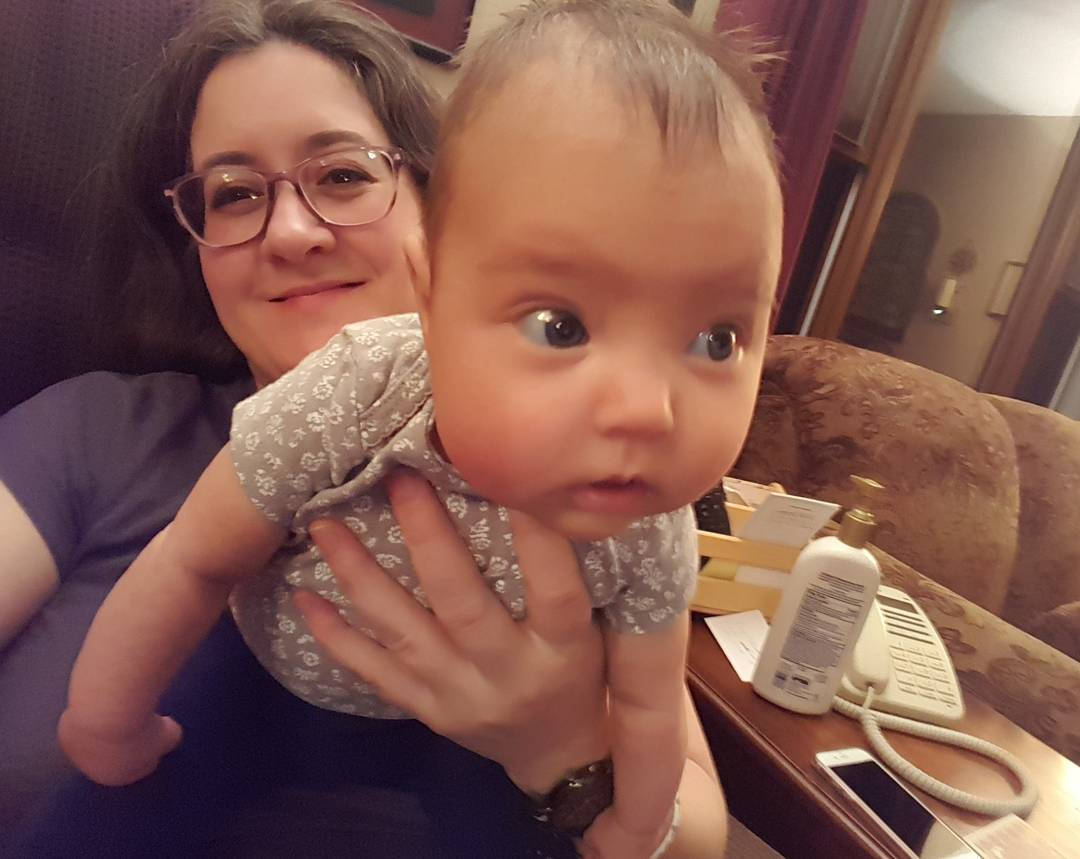
But the niece knitting is caught up for a moment and when I was sick last week and felt too dull to read, I got to poking around and found that Malabrigo cowl.
 |
| That Nice Stitch cowl. The photo doesn't do the Malabrigo justice, but it's winter and I don't own a lightbox. Sorry. |
It really only took the month of February. February 2017 and 2018, but still. I'm calling it February.
And since I was sick for six days and the cowl only needed a couple of inches, I had time to finish up the socks I was planning to wear for St. Patrick's Day. In 2017.
 |
| Geek Socks from knitty.com. Such a fun way to use self-striping yarn! |
I'm finally healthy and off the couch, but I feel like I'm on a roll with the UFOs, so I went rummaging again and came up with some yarn barf that's been rolling around in a project bag since 2013.

I hope in a couple of weeks that hot mess will be a Hey Teach cardigan. Wish me luck!
Friday, January 26, 2018
And the Best Books I Read This Year (2017)
Yup, that's all this blog is now: annual reviews of the books I liked the best. Sorry I haven't been posting, promise to do better, blah, blah, blah, nobody cares.
So let's get to it. Based on the "would I re-read it" premise, the list is pretty small, so stay tuned for some honorable mentions at the end.
Aiken, Joan. 1963. The Wolves of Willoughby Chase.
Last year I was entranced by The People in the Castle, and this year I read and loved several of Aiken's children's books. Somehow I missed these books when I was the "right" age, and that is a bit of a tragedy; the spirit of adventure embodied in Aiken's stories would've done my childhood good. I'll go beyond saying I "would" re-read it to promise that I will re-read it with my niece when she's old enough.
Chambers, Becky. 2014. The Long Way to a Small, Angry Planet.
I don't seek out much sci-fi and actually picked this up thinking it was something else. What a serendipitous mistake! The story, full of space adventures and imaginative tech, is entirely character driven and addresses intense themes of belonging. And it's well written and just a lot of fun. As soon as I finished Long Way, I immediately read the sequel, A Closed and Common Orbit, which follows characters who were tangential to the first story. I've already placed my library request for the third in the trilogy, Record of a Spaceborn Few, which is scheduled to be released in July 2018.
Dickey, Colin. 2016. Ghostland: An American History in Haunted Places.
Dickey approaches American history and culture through our most famous hauntings. He manages to debunk many of our favorite ghost stories but still creep me out anyway!
And that's it. Those are the three books I read in 2017 that I would willingly re-read if suddenly new books ceased to appear.
Here are the honorable mentions I really enjoyed but that don't make the re-read list. Oddly for me, these are all nonfiction. What? Nonfic? No, yes, really.
Waldman, Ayelet. 2017. A Really Good Day: How Microdosing Made a Mega Difference in My Mood, My Marriage, and My Life.
The drug war is dumb and prevents people from accessing help that could change their lives.
Winter, W. Chris. 2017. The Sleep Solution: Why Your Sleep Is Broken and How to Fix It.
I have a secret weakness for self-help books, and sleep is something I have worried about a lot in my eternal quest to become bigger, stronger, faster without having to do anything boring or dumb like exercise or eat well or change my lifestyle in any way. The Sleep Solution gets into the nitty-gritty of how sleep works, but does so in accessible language. The book changed my perception of sleep and I actually became more satisfied with my sleep the very week I finished it. (On a slightly bizarre note, on GoodReads I mildly criticized the author's habit of inserting jokes as footnotes, thereby interrupting himself over and over and over for no good reason. The author responded personally to defend his choice, which was . . . odd. You'd think an internationally known sleep doctor would have better things to do with his time than stalk GoodReads reviews.)
Yang, Kao Kalia. 2008. The Latehomecomer: A Hmong Family Memoir.
The Latehomecomer was the 2017 Big Read selection for the Wichita Public Library. Many of my co-workers didn't love this book as much as I did. I was particularly struck by the fact that Yang and I are close to the same age. While I was running around the playground at OK Elementary, she was running around a refugee camp. Our grandmothers even died within a month of each other. So I felt a particular interest in and affection for Yang's well-told story.
So let's get to it. Based on the "would I re-read it" premise, the list is pretty small, so stay tuned for some honorable mentions at the end.
Aiken, Joan. 1963. The Wolves of Willoughby Chase.
Last year I was entranced by The People in the Castle, and this year I read and loved several of Aiken's children's books. Somehow I missed these books when I was the "right" age, and that is a bit of a tragedy; the spirit of adventure embodied in Aiken's stories would've done my childhood good. I'll go beyond saying I "would" re-read it to promise that I will re-read it with my niece when she's old enough.
Chambers, Becky. 2014. The Long Way to a Small, Angry Planet.
I don't seek out much sci-fi and actually picked this up thinking it was something else. What a serendipitous mistake! The story, full of space adventures and imaginative tech, is entirely character driven and addresses intense themes of belonging. And it's well written and just a lot of fun. As soon as I finished Long Way, I immediately read the sequel, A Closed and Common Orbit, which follows characters who were tangential to the first story. I've already placed my library request for the third in the trilogy, Record of a Spaceborn Few, which is scheduled to be released in July 2018.
Dickey, Colin. 2016. Ghostland: An American History in Haunted Places.
Dickey approaches American history and culture through our most famous hauntings. He manages to debunk many of our favorite ghost stories but still creep me out anyway!
And that's it. Those are the three books I read in 2017 that I would willingly re-read if suddenly new books ceased to appear.
Here are the honorable mentions I really enjoyed but that don't make the re-read list. Oddly for me, these are all nonfiction. What? Nonfic? No, yes, really.
Waldman, Ayelet. 2017. A Really Good Day: How Microdosing Made a Mega Difference in My Mood, My Marriage, and My Life.
The drug war is dumb and prevents people from accessing help that could change their lives.
Winter, W. Chris. 2017. The Sleep Solution: Why Your Sleep Is Broken and How to Fix It.
I have a secret weakness for self-help books, and sleep is something I have worried about a lot in my eternal quest to become bigger, stronger, faster without having to do anything boring or dumb like exercise or eat well or change my lifestyle in any way. The Sleep Solution gets into the nitty-gritty of how sleep works, but does so in accessible language. The book changed my perception of sleep and I actually became more satisfied with my sleep the very week I finished it. (On a slightly bizarre note, on GoodReads I mildly criticized the author's habit of inserting jokes as footnotes, thereby interrupting himself over and over and over for no good reason. The author responded personally to defend his choice, which was . . . odd. You'd think an internationally known sleep doctor would have better things to do with his time than stalk GoodReads reviews.)
Yang, Kao Kalia. 2008. The Latehomecomer: A Hmong Family Memoir.
The Latehomecomer was the 2017 Big Read selection for the Wichita Public Library. Many of my co-workers didn't love this book as much as I did. I was particularly struck by the fact that Yang and I are close to the same age. While I was running around the playground at OK Elementary, she was running around a refugee camp. Our grandmothers even died within a month of each other. So I felt a particular interest in and affection for Yang's well-told story.
Friday, December 30, 2016
The Best Books I Read This Year
This has really been a banner year for good books. Am I getting better at choosing? Are my tastes expanding? Probably yes.
To choose these books, I went through all my 2016 GoodReads reviews asking myself if I would re-read that book. I don’t re-read very often, but, in the unlikely event that authors stopped writing new books and I got caught up on all the books ever published and had literally nothing else to read, these are the books I would happily read again. These are also the books I try to push on friends and library patrons whenever possible. (Seriously. I sent a woman home with Ghost Summer just last week. I’ll consider it a personal affront if she doesn’t enjoy it.) They’re listed in alphabetical order by author; no ranking is implied. I read the books this year, but most of them were not published in 2016.
Aiken, Joan. 2016. The People in the Castle.
Aiken died in 2004 before I had ever even heard of her. Luckily for me, her daughter repackaged and republished some of her short stories as The People in the Castle, which got written up on some blog or website or other, and I had a chance to discover her unique, beautiful fairy tales. I’m looking forward to working through her immense bibliography.
Due, Tananarive. 2015. Ghost Summer.
Ghosts stories, people! GOOD ghost stories! And monster stories and human stories and human-monster stories. If you like your literature with a side of creepy, dive in.
Jackson, Shirley. 1962. We Have Always Lived in the Castle.
Shirley Jackson. That is all I have to say. Oh, except for: Thanks, Milton, for reminding me I had been meaning to read this.
Kingsolver, Barbara. 2009. The Lacuna.
Reading about Stalinist Russia and the American anti-Communist hysteria of the 1950s at this particular political moment was grounding. Recalling these eras in history has reminded me that nothing we are going through now is new; there have always been people who tried to enforce one particular way of being American. Pluralism is a luxury we are frequently not allowed to enjoy. And Kingsolver is always good.
Mandel, Emily St. John. 2014. Station Eleven.
I dig stories about how people cope with the end of “civilization.” This one is particularly good.
Yapa, Sunil. 2016. Your Heart Is a Muscle the Size of a Fist.
Tells the story of the 1999 WTO protests in Seattle from the perspective of the protestors, the officers, and a diplomat.
Honorable Mention
I particularly enjoyed these, but they’re not “re-readable.”
Bradbury, Ray. 1953. Fahrenheit 451.
Butler, Octavia. 1979. Kindred.
Hernandez, Carlos. 2016. The Assimilated Cuban’s Guide to Quantum Santeria.
Hugo, Victor. 1862. Les Miserables.
Nguyen, Viet Thanh. 2015. The Sympathizer.
West, Lindy. 2016. Shrill: Notes from a Loud Woman.Sunday, August 28, 2016
What It's Like to "Own" a Dog
You’re supposed to get up at the
same time every day, and that’s where dogs come in, because if you get up at
6:15 five days a week, she’s pretty much going to insist that you get up at
that time on days off, too. And then refuse to go out because the neighbors’
sprinklers are running and the noise is too scary. So you have to put on pants
and put her in her harness and take her out front. You think you’ll just take
her in the front yard and she’ll do her business and you can come back in, but
nowhere in the front yard meets her demanding pee spot specifications, so you
end up walking up the street and finally, three houses up, she squats. Okay.
You can turn around and go home now. Except now she thinks you’re on a walk and
doesn’t want to go home. There are
things to smell in the next block, dammit! So when you try to turn back, she
plants her little feet and, in an astounding abrogation of the laws of physics, turns her stocky little fifteen-pound
body into a hundred-pound boulder. When you pull on the leash, she tries to
bite it. You could pick her up. But.
So.
You decide screw it, claw the sleep crust out of your eyes, and start walking,
wondering if the neighbors saw you lose a war of wills to an adorable floof
ball. “I didn’t bring a poop bag,” you tell her. “We weren’t supposed to leave
the yard. So don’t poop.” And you walk, thinking about how good it is that you
have a dog who forces you to exercise and isn’t this what you wanted in the
first place when you decided to adopt dogs? A reason to force you out of the
house? So this is good, right? Right?
And
then she poops.
Saturday, April 23, 2016
Wichita, Take a Look
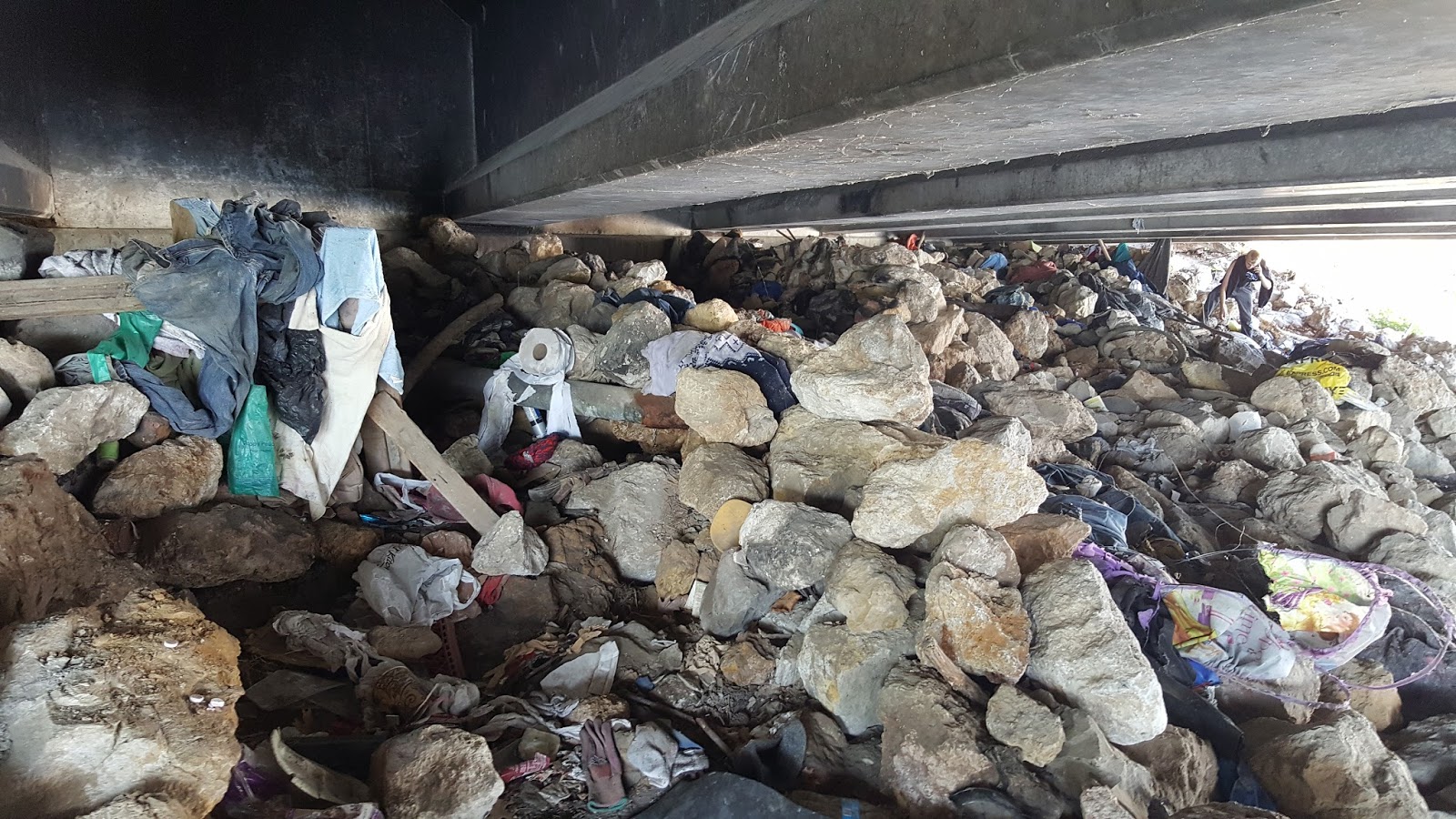
I saw something today that everyone in Wichita needs to take a look at. I volunteered for the river cleanup this morning and somehow ended up under the Seneca Street bridge next to the Indian Center, where people have lived.
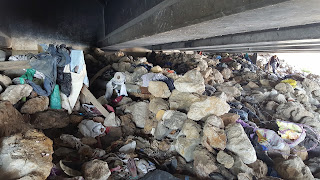
I and a friend, along with other volunteers, spent 2 hours filling five garbage bags. It took so long because we had to spend time deciding whether everything we touched was garbage or someone's belonging. Empty cigarette packs: trash. Plastic dishes: leave them. Clothes: wearable or shredded? I folded four or five tee shirts and left them on a rock next to a stack of waterlogged but still readable paperbacks (a Nora Roberts, a James Patterson, Angels and Demons by Dan Brown, and a book about the Titanic). We dug a heavy winter coat out of the bank that looked like it was in good condition, but was so waterlogged and muddy that it would've needed professional drycleaning to be wearable again. We decided to throw it away. I've spent the rest of the day thinking up scenarios that could explain the presence of a plastic dollhouse, none of them good.
All the while, we had to negotiate the boulders and rubble that cover the bank. No one is meant to walk down there, and it isn't safe. Boulders shift as you step on them. Falling on the sharp rock would mean bruises at a minimum, if not broken bones. G's foot slipped between two rocks, and there was a scary moment when I thought she had turned her ankle and we were going to have to figure out how to get us both out of there without hurting ourselves worse. There is no place where someone could stretch out comfortably to truly rest.
The rubble does serve a purpose, though. It's been stacked into small walls so each person has a semi-private area. There were four or five little "apartments" with a communal bonfire area close to the river. Clothes, particularly denim, and styrofoam along with driftwood seem to have been the main sources of fuel. There were empty Ramen packages; I hope it wasn't cooked in river water.
This is the bridge north of the Indian Center where Seneca turns into Greenway. Beautiful Riverside homes are right across the river. The Art Museum is just up the street. We have all driven along here and walked the bike paths to the Keeper of the Plains about a half-mile or so away. Of course I had heard that people lived under Wichita's bridges, but I hadn't seen it. I didn't really know what that meant.
I'm not asking you to volunteer or give money or even change your ideological or political opinions. I'm not trying to guilt you, I swear. I just want you to look, to know that this is Wichita, too.
I and a friend, along with other volunteers, spent 2 hours filling five garbage bags. It took so long because we had to spend time deciding whether everything we touched was garbage or someone's belonging. Empty cigarette packs: trash. Plastic dishes: leave them. Clothes: wearable or shredded? I folded four or five tee shirts and left them on a rock next to a stack of waterlogged but still readable paperbacks (a Nora Roberts, a James Patterson, Angels and Demons by Dan Brown, and a book about the Titanic). We dug a heavy winter coat out of the bank that looked like it was in good condition, but was so waterlogged and muddy that it would've needed professional drycleaning to be wearable again. We decided to throw it away. I've spent the rest of the day thinking up scenarios that could explain the presence of a plastic dollhouse, none of them good.
All the while, we had to negotiate the boulders and rubble that cover the bank. No one is meant to walk down there, and it isn't safe. Boulders shift as you step on them. Falling on the sharp rock would mean bruises at a minimum, if not broken bones. G's foot slipped between two rocks, and there was a scary moment when I thought she had turned her ankle and we were going to have to figure out how to get us both out of there without hurting ourselves worse. There is no place where someone could stretch out comfortably to truly rest.
The rubble does serve a purpose, though. It's been stacked into small walls so each person has a semi-private area. There were four or five little "apartments" with a communal bonfire area close to the river. Clothes, particularly denim, and styrofoam along with driftwood seem to have been the main sources of fuel. There were empty Ramen packages; I hope it wasn't cooked in river water.
This is the bridge north of the Indian Center where Seneca turns into Greenway. Beautiful Riverside homes are right across the river. The Art Museum is just up the street. We have all driven along here and walked the bike paths to the Keeper of the Plains about a half-mile or so away. Of course I had heard that people lived under Wichita's bridges, but I hadn't seen it. I didn't really know what that meant.
I'm not asking you to volunteer or give money or even change your ideological or political opinions. I'm not trying to guilt you, I swear. I just want you to look, to know that this is Wichita, too.
Monday, June 1, 2015
Sockghan Square 4
Vacation is looming, and I wanted to do a square based on Knitty's Inlay before I leave because this is not a road trip square.

The twisted stitch technique isn't difficult (it's similar to cabling, except instead of reversing the order of the stitches and then knitting them, you knit the stitches out of order), but it's not a "Hey, look at that!" kind of project. Car passenger knitting has to allow for lots of knitting without looking. I don't want to come home and find that my clearest memories are of yarn! So this is a no-go for actual trip knitting, but I was dying to see how it would come out as a square.
The sock pattern has a plain knit round that works as a purl row in the flat version, so it works just fine, but I'm not in love with how I spaced the pattern itself into the square. I'd like to do another one with a little more attention to fitting the pattern into the square less awkwardly. This will probably involve working it out at sometime that is not after 10pm. This is no more suited for bedtime planning than it is road trip knitting.
We leave in a few days. In the next post I hope to have a whole stack of squares to show off!

The twisted stitch technique isn't difficult (it's similar to cabling, except instead of reversing the order of the stitches and then knitting them, you knit the stitches out of order), but it's not a "Hey, look at that!" kind of project. Car passenger knitting has to allow for lots of knitting without looking. I don't want to come home and find that my clearest memories are of yarn! So this is a no-go for actual trip knitting, but I was dying to see how it would come out as a square.
The sock pattern has a plain knit round that works as a purl row in the flat version, so it works just fine, but I'm not in love with how I spaced the pattern itself into the square. I'd like to do another one with a little more attention to fitting the pattern into the square less awkwardly. This will probably involve working it out at sometime that is not after 10pm. This is no more suited for bedtime planning than it is road trip knitting.
We leave in a few days. In the next post I hope to have a whole stack of squares to show off!
Subscribe to:
Posts (Atom)