Tuesday, July 30, 2013

A Knitter's Word Problem

Noelle accidentally knit an extra pattern repeat, including increases, on the yoke of the February Lady Sweater. She now has 235 stitches, but she only needs 227. Should she:

A. Tink back 470 stitches.

B. K2tog 8 times.

C. You know you can buy sweaters at Target, right?


Next week's problem: If Knitter 1 leaves the LYS at 10:45 am with a bag of Malabrigo and Knitter 2 leaves Michael's at 11:02 with a bag of Patons Kroy, they will have a violent and virulent disagreement on Ravelry about yarn quality at what time?

Thursday, July 4, 2013

Here There Be Monsters, Y'all! No, really.

I've discovered the solution to the tepid second novel that critics' lore insists a promising young novelist will inevitably produce. Just wait and read the second novel first, and then go back and read the first. Earlier this year I read Arcadia, Lauren Groff's second novel. It was good. Darn good, in fact. So good it was one of the contenders in the Tournament of Books.

But I just finished The Monsters of Templeton, Groff's debut novel published in 2008, and it blew Arcadia right out of the water. Monsters has, well, a monster. A real one. We're not talking some metaphoric mental monster, but an actual, honest-to-god, lives-in-the-lake, and may-or-may-not-be-drowing-people monster.

And yes, okay, the monster is in fact symbolic of the monstrous secrets being kept in the town that surface at the same time as the monster. It wouldn't be lit-rah-cha if there wasn't any symbolism, of course. But Groff took what could've been an average novel on well-worn themes (daddy issues much?) and pulled the story-telling equivalent of lifting a rabbit out of a top hat. Except the rabbit isn't a boring old rabbit. It's a monster. A real, live monster, "huge, a heavy cream color that darkened to lemon in places. . . . It looked like a carp grown enormous, with a carp's fat belly and round eye, but with a long, articulated neck like a ballet dancer's and four finned legs, plump as a frog." When was the last time you got to read about a monster outside of a horror novel? Never, yeah?

On more, shall we say, traditional grounds, the novel is just as skilled as Arcadia. It looks at similar themes in terms of what constitutes a family, how perceptions and knowledge are formed, and what happens when a new reality intrudes. The main character, Willie Upton, searches her family's history to reveal her own "monsters," which for the most part aren't that monstrous, but really are only the departures from "authorized" history that happen in every family. As Willie explores her family's history back to her founding ancestors in the 18th century, Groff explores the quintessential American family in microcosm, and thus presents us with a portrait of our own American geniture. Although Willie is the protagonist who must live with the consequences, Groff lets each generation tell its own story and make its own confessions. Each generation's story is layered on another, not necessarily in chronological order, creating new understandings of what it means to be Willie Upton, and, for the rest of us, what it means to be a descendent of the American experiment—although that really sounds too grand for the immediate, intimate nature of this story.

As in Arcadia, Groff's prose is impressive. It manages to be exquisite and delicate without looking like she tried to make it exquisite and delicate. In the course of the week or so that I was reading Monsters, I found myself thinking in Groff's voice, the way you do when you're engrossed in a novel. Letting an author infect my brain like that is probably the highest praise I can give any writer.

So you must definitely read The Monsters of Templeton, not least because it is a relevant story told in beautiful prose. But mostly you must read Monsters because of the monster. How often as an adult do you get to read about a monster you can really believe in?

Oh, and the friendly if somewhat anal-retentive ghost. Did I mention the ghost? I can't believe I forgot to tell you about the ghost!

Friday, June 14, 2013

Because the hell-hound is adorbs.

You've read Good Omens: The Nice and Accurate Prophecies of Agnes Nutter, Witch, right? You know, the comedic novel about Armageddon that Neil Gaiman and Terry Pratchett coauthored and published 23 years ago? You've read that, right? I assume pretty much everyone except me has read it, and I just finished it, so I assume now everyone's read it.

But if for some reason you haven't gotten around to it yet, here are some reasons you might enjoy it:
  • Gaiman and Pratchett apparently loathe Queen as much as an approaching-middle-aged Midwestern woman—that is to say, me.
  • The vicious hell-hound sent from the underworld to accompany the preadolescent Antichrist has no choice but to become a lovable family pet—or else the Antichrist's dad won't let him keep it. "It had always wanted to jump up at people but, now, it realized that against all expectation it wanted to wag its tail at the same time."
  • It's got a lot of Sunday Morning theology beat (and Friday Night and Saturday Afternoon, for that matter). The young Antichrist wonders, "I don't see what's so triffic about creating people as people and then gettin' upset 'cos they act like people." Yeah, me neither.
  • An entire room of telemarketers is consumed by a huge demonic maggot consisting of millions of tiny demonic maggots. Seems okay, yeah? 
  •  A witch being burned at the stake manages to blow up her entire village in the process. Serves 'em right.
  • The Antichrist is unusually practical for an 11-year-old, not to mention astonishingly polite: "I don't want any more world than I've got. Thank you all the same."  
 
Here are some reasons you might not enjoy it:
  • There are so many references to Queen that you'll catch yourself singing "Scaramouche! Scaramouche! Will you do the fandango?" under your breath to yourself at least twice. And then you'll probably have to pay royalties to BMI or somebody.
  • That's really all I've got. 

Tuesday, June 11, 2013

Next Stop: Amish Romance Novels

Letting your reading life be determined by your library holds queue makes for an interesting, if sometimes disconcerting, reading experience. There I was taking a leisurely and enjoyable stroll through Good Omens: The Nice and Accurate Prophecies of Agnes Nutter, Witch, when NOS4A2, a story by Joe Hill about a vampire named Manx who feeds on children, showed up. It's a new release and therefore a two-week checkout with no renewal, so I dropped Agnes and found myself speeding down inscape highways and through mysterious covered bridges with Vic "Brat" McQueen as she tries to rescue her son from the evil Manx and his dominion, Christmasland. Talk about whiplash.

I can't say I particularly enjoy gruesome horror stories anymore, and certainly don't normally seek them out. But I had read an article about Hill and NOS4A2, and was curious enough to give it a shot. I wasn't going to beat myself up if I didn't finish, though. 

But here's the thing: Joe Hill is an excellent storyteller. It might be in his genes, since his dad is Stephen King. It's clear that Hill learned his craft by reading and re-reading and re-reading his dad. Would the similarities of style and tone have occurred to me if I hadn't known about the relationship? Probably. It really is very "Kingish." Hill acknowledges as much when he writes in the acknowledgments of "cruising [King's] back roads my whole life," and even said in an interview that he thought "it would be fun to goof on Stephen King a bit."

And here's another thing: Hill is better than his dad—or at least, shall we say, fresher. It's sort of like the difference between drinking the same iced tea you've been drinking your whole life, which is perfectly fine, and drinking raspberry iced tea with lemon—the same, but better, if you like that sort of thing.

But here's a third thing: The horrifying bits, unfortunately, are pretty much rote. You know in a book like this there's going to be a pretty fair amount of gore for anyone who inadvertently crosses Manx's path. And there is. When a dog is introduced midway through, you just know that dog isn't going to make it out alive, and it's probably going to be a pretty gruesome death. And it is. And that's where I lose patience. Yes, because it's a dog, and it shouldn't be any secret how I feel about thinking mildly hard-hearted thoughts about an animal, let alone actually hurting one, but also because there's plenty of real-life horror all around us, and fictional horror feels less like an escape and more like something that shouldn't be permitted to take up anymore space in my brain than absolutely necessary. That guy in Cleveland who kept those three women locked up for years? There's a child-eating vampire for you.

So, yes, Hill is a helluva writer and a helluva storyteller. By all means, check him out if you haven't already. I'm glad I did. But in general, although I'm not quite to the point of taking up Amish romance novels for my escapist reading, I think I'm past wanting to read about bone mallets and intestinal gristle for fun on rainy Sunday afternoons.

Saturday, May 25, 2013

Towel Day

Edgar was my second cat. My first cat, Lucy, died when she was only a year old of unexplained liver failure. A couple of weeks after she died, I took her food to the Humane Society to donate, and when I turned around, there was a young cat staring at me from a cage at eye level. He so clearly wanted the hell out, so I took him home. That was November 1996.

Edgar was an attack cat. Ankles, knees, anything that moved was fair game. He was also and often simultaneously a snuggler. He's the only cat I've ever known who never got tired of being petted. He never got up and walked away. When his tail started switching back and forth, you knew it was time to stop moving your hand around, but you were not supposed to stop touching him. This made getting work done challenging.

When I called the Humane Society this morning to ask about euthanasia and cremation (our vet is closed for the holiday weekend), his tail suddenly started switching again. He'd been perfectly still all morning, and you would've sworn that he understood what I was doing and was objecting. But I spent the whole day with him, just sitting with him, and it wasn't a mistake. His back legs stopped working yesterday, and at first he could pull himself around, but he also didn't want to eat, hadn't eaten since Wednesday in fact, so today he was too weak to move on his own at all. Every once in a while he would struggle and I would sit him up so he could roll over onto his other side. That was all he seemed to want. He never purred today at all. I'm pretty sure this was the first day of his life when he never purred.

We spent the morning on the sun porch, and then when it got too hot I carried him in to my bed, and turned on the fans and opened the windows so he could keep smelling the fresh air, at the same time that I shut all the other windows in the house and turned on the AC to try to keep him cool.

My sister was supposed to pick us up at 4:30, and when I saw that the clock said 4:08, I thought I was going to throw up. I took a Pepto just in case. I still don't know how I did that, got Edgar into his crate, carried him into the car, and answered "yes" when the veterinarian asked if I was ready. I don't know how anybody ever does that because clearly I am NOT FUCKING READY. But Edgar was. He was mad as hell because he couldn't move, was mad as hell at being in an exam room, and he needed out. It was my job to get him out of that cage 16 years ago, and it was my job to get him out today.

I'm so glad I asked my sister to go with me. Seriously, the next time you have to put a pet to sleep, take my sister with you. She'll cry right along with you so you don't feel stupid. My arms were busy holding onto Edgar, so she couldn't hold my hand, so she held my leg instead. The most comforting thing that happened all day was my sister's hand wrapped around my shin while I had my arms wrapped around Edgar. I don't think she realized that.

The hardest part in any death for me is finally leaving the person behind. (Yes, person. I dare you to tell Edgar that he's not a person.) I was taken by surprise by that when my grandfather died when I was 12. He'd been sick for a while, and we'd spent a week in the hospital with him, and then at the funeral home and the church, and when the graveside was over and I realized that we were just going to walk away and leave his coffin, that's when I got really upset.

So today before it was time to go, I realized that was going to be hard, but I found a solution. I got the towel out of his crate and laid him on it. It made it okay to leave. I told the staff that I had left the towel, and they assumed I wanted it kept with him, but I told them they could wash it and use it. (The Humane Society can always use towels.) I just needed it to be there when I left the room, so he wouldn't be alone. And now I'm toting the towel he's slept on all day around with me. This is the towel that's been in his crate most of his life. At some point recently there was a laundry switch, and another old towel was the one that went to the Humane Society today and that I left with him. This is the one that's ridden in his crate for years, and is snagged and partly shredded. It's the one I think of as "Edgar's Towel." I can't make myself put it down yet. If anyone comes to my door tonight, they will find a red-eyed, red-nosed woman carrying around a ratty old towel.

The fact that it's Towel Day is not lost on me. I know where my towel is, and Edgar has his, too, so we're all going to be all right.

Tuesday, May 14, 2013

Kids These Days

I hardly know where to begin. Maybe my first stop should be a caveat about how the public institution where I spend a small part of my working life attracts patrons of all ages, from 1 to 101. Rarely does a day pass when some child does not throw a temper tantrum, an embarrassed caregiver desperately shushes said child, and some third person, usually someone over 50, remarks under his breath that in his day, children weren't allowed to behave so abominably.

The third person—or rather, people, because they are legion—drive me bats. I know perfectly well that in their day things were not so wonderful as they misremember. In their day, children threw just as many temper tantrums as they do now, and caregivers tried just as desperately to shush them. In their day the child was probably more likely to get smacked for misbehaving, but I'd rather listen to a kid scream until light bulbs shatter than see one get hit, so I'm glad I live in my day, not theirs.

So I have no patience for people who start their conversations with, "In my day. . . ."

And yet. In my day. . . . 


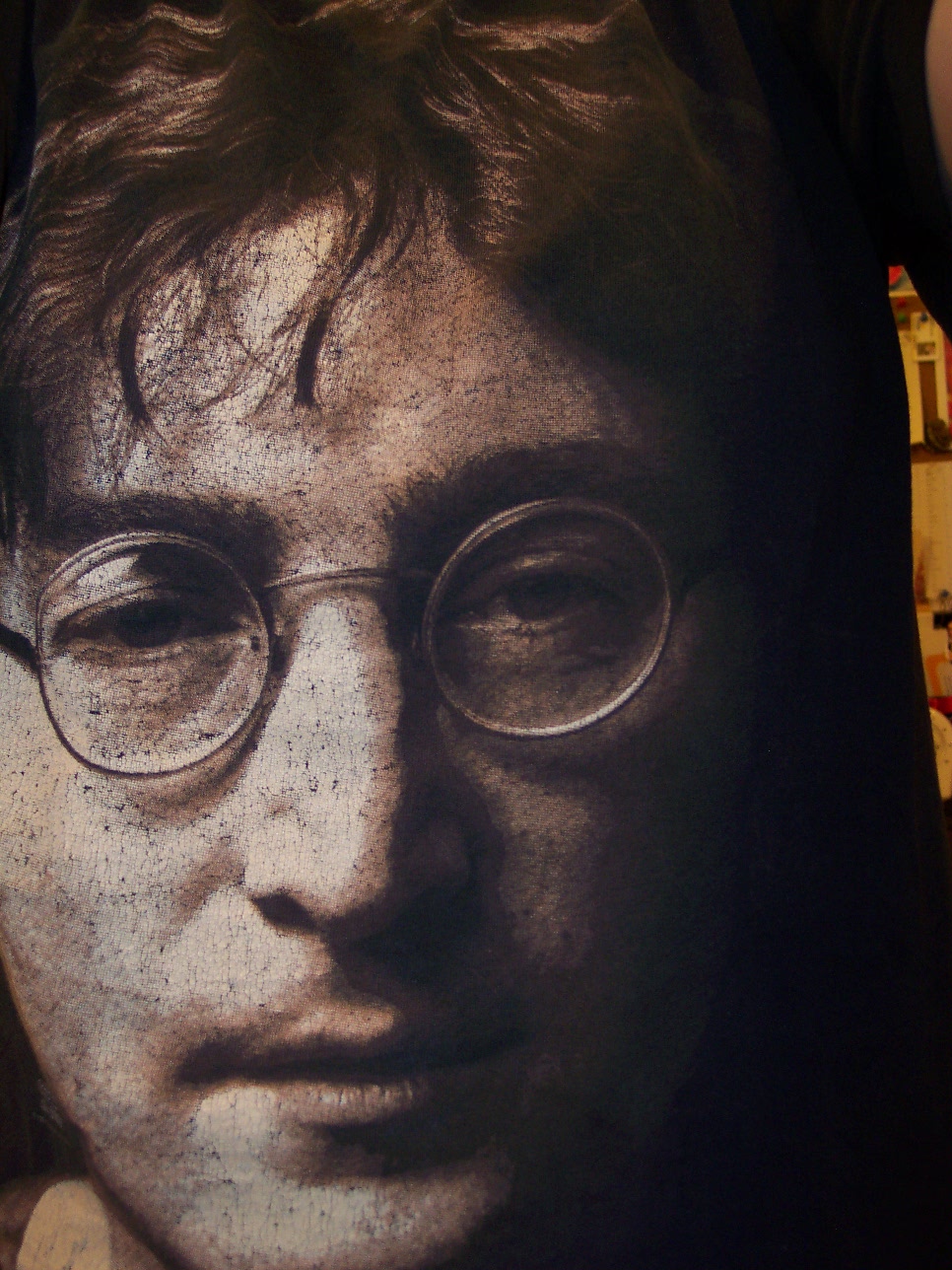
I wore my John today. John is the last in a long line of college tee shirts. I'm not sure why he's held up so well, maybe because the plastic or whatever it is his giant head is made of reinforces the fabric. For whatever reason, John is still with me. I love him dearly and will wear him until he's in tatters, when he will be placed lovingly into the storage tub with all my other favorite tee shirts that have become little more than fragments. I'm sure the Billie Holiday tee shirt will welcome him home as a long-lost friend.

Now you may not have noticed it—I know I certainly didn't at first—but this photo of John bears a superficial resemblance to another contemporary pop culture icon, a certain orphaned wizard we all know and many of us love. The first time I was in a grocery store and a 6-year-old pointed at my shirt and yelled "Harry Potter!" I was surprised, but not for long. It's the round glasses, you see.

So even though I hadn't been planning a pop culture lesson, I was a little more prepared when I wore John to after-school tutoring and five kids simultaneously pointed and screamed "Harry Potter!" (Seriously, they all scream. Harry Potter apparently engenders the kind of emotion in children not seen since teen girls fell in love with the Beatles themselves.) "No," I said, "This is a musician named John Lennon. When you get home tonight, ask your parents if you can listen to some music by the Beatles. No, not like the bugs. Seriously, just ask them. I'm not kidding." If even one child got to hear "I Want to Hold Your Hand" that night, I feel that I've made the world a better place.

This evening, though, when a 20-something clerk, a young woman with dyed black hair and a nose ring, a young woman who is clearly working so hard to be hip and alternative, looked at my tee shirt, my John, and felt compelled to comment on a recent Harry Potter marathon on TV, I was not prepared.

When did our culture get into this state? When did our young adults forget about the "long-haired hippies" who paved the way for their nose rings? When did the youth of today forget about the original "alternative" music? Where are their parents?! 

In my day, any teenage rebel worth her salt could recite the entire White Album. In my day, even when we were listening to Pearl Jam and the Chili Peppers, we still remembered who our rock and roll ancestors were. In my day. . . . 

Well.

Something has to be done. I'm proposing that we all celebrate Beatles Day. July 10, the anniversary of the day the Fab Four returned to Liverpool after they "conquered" the United States in 1964, is the official Beatles Day, but I don't think we can wait until July. We need the Beatles now!

So find your Abbey Road CD, or dig through that old box of cassette tapes if you have to. If you have kids, please, please, for the sake of our future as a nation, as a culture, as a world, please sit them down and explain the British Invasion. Explain to them that the Harry Potter stories are great fun, but what John, Paul, George, and Ringo did was nothing short of revolution.  

Me, I'm going to start celebrating immediately. "Rocky" was always one of my favorites.


Thursday, April 25, 2013

Reading Journal: The Good, the Bad, and the . . . let's just stop there.

Earlier this week I returned The Night Circus to store even though I was only about halfway through it. I was so disappointed. Everyone seemed to love it so, and I thought I would love it, but given that it took me two months to read 214 pages and there were still 170-some pages to go, love does not seem like the thing that was happening.

Morgenstern tried so hard to make the story elegant that it became nothing but caricature. It's supposed to be a battle between magicians, which sounds a lot more interesting than Morgenstern manages to make it—at least as far as I read. The illusions are too perfect, too intricate, the characters too exactly what you would expect of them. After a while the detailed descriptions of the magic contained in the circus become downright wearisome, and in the meantime I was longing to learn more about the characters outside their roles as performers. The only action I found compelling was Celia's refusal to let her father change her name. That happened on p. 11. I read 203 more pages waiting for someone to do something admirable and/or interesting. Yes, there's lots of magic and illusion, and it's all "Interesting," but none of it is actually interesting.

Sometimes I have to remind myself that I get paid to read textbooks and student essays. No one is paying me to read novels, so when I'm reading "off the clock," as it were, I have the right to enjoy it. So I gave myself a little mental shake, retrieved my favorite bookmark, and back to the library it went.

Turns out I dropped Circus at exactly the right time because Where'd You Go, Bernadette, by Maria Semple, happened to show up in my holds queue the very same day. (If you've already read it, visit the link just for the doll. I am going to need a Bernadette doll.)

Bernadette is everything Circus is not. Primarily that consists of being believably unbelievable, with characters who are loveable because they are interchangeably flawed and redeemable, sometimes one or the other moment to moment, usually both at the same time. The story of a misanthropic, semi-agoraphobic* famous architect and her family is constructed through a series of e-mails, memos, transcripts, articles, and other electronic ephemera. It looks like the stack of research someone getting ready to write a book would compile, not the book itself, and at first I thought that conceit would drive me batty, but I wound up sinking right in. It's an excellent way to execute sudden shifts in point of view. In fact, when Semple switched to traditional first-person narration at the end, it was a little disconcerting. It was the only off-note in what I am unashamedly calling a symphony of awesome.

Okay, I'll admit the ending of Bernadette is maybe not the most believable denouement in all of literature, but it works because you want it so, so badly. I was prepared for the story to end in the predictable, practical way. I would've understood. But when it took that one final twist, I was so pleased and excited that I literally gasped aloud. Bertie Sue, who is offended by all unexpected noises, even relatively quiet ones, woke up and gave me the glare of death. I'm seriously thinking of proposing her as the library mascot. Having been suitably chastised, I finished the rest of the book wearing a huge (silent) grin.

So, to conclude, The Night Circus: Skillful writing, really boring plot—or more probably an interesting plot poorly executed. If you're really into magic, read it just for the descriptions of the circus; otherwise, skip it and reread Jonathan Strange and Mr. Norrell instead. Where'd You Go, Bernadette: Read it. Do you hear me? Read it!

*Yes, yes, I know.  

P.S. I had forgotten that Bernadette was one of the contenders in the 2013 Tournament of Books. That's how it made it onto my reading list in the first place. It lost its round to The Orphan Master's Son, which ultimately won the tournament. I suppose I'll have to it read now, though it doesn't sound like near as much fun.